The Way We Approach Learning at Home
A simple cycle of reading, making, and sharing that slowly shaped how our children think and learn.
Most of us consume a lot of information. We read books, watch videos, attend talks, or listen to podcasts. But a few days later, most of what we consumed fades away.
The learning that stays usually follows a different path.
In my own work and learning, I began to think of it as three phases: consume, produce, and share.
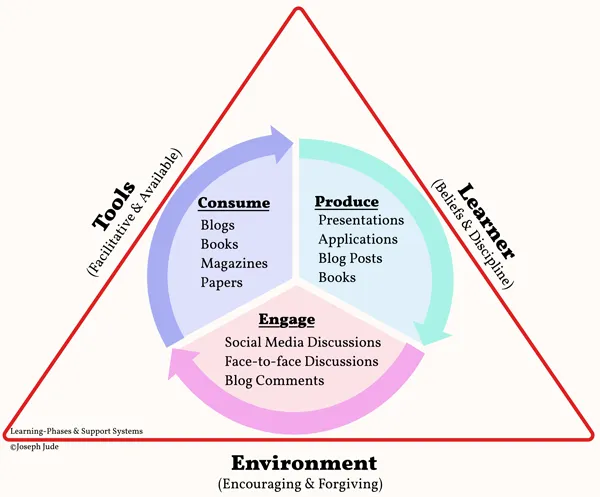
The first phase is consumption.
This is exposure. Reading books. Watching lectures. Browsing articles. Listening to thoughtful conversations. It introduces ideas, but by itself it rarely produces deep understanding.
The second phase is production.
Here the learner creates something from what they consumed. It could be a short article, a presentation, a small application, or even a personal note explaining an idea.
This step forces the mind to organize thoughts. You discover where your understanding is clear and where it is still vague.
But the third phase is where learning becomes deeper: sharing.
When you publish or present your work, other people respond. Sometimes they agree. Sometimes they question your thinking. Sometimes they add ideas you had not considered.
Over time you learn how to engage thoughtfully with others. You also learn that disagreement does not have to become hostility. It can simply be part of learning in public.
This small cycle—consume, produce, share—has shaped the way I approach learning at home.
One practical way this shows up in our family is through blogging.
A few years ago I installed WordPress sites for both of my sons and asked them to write about things they found interesting. I never assigned topics. The only expectation was that they write about what they were learning or thinking about.
Over time their blogs began to reflect their personalities.
My younger son writes about gadgets, travel, and things he is curious about. He enjoys comparing devices, describing places we visit, and experimenting with photography.
My older son has a more reflective temperament. He writes about philosophy, psychology, and sometimes travel. Occasionally he also writes about books he is reading or tools he is experimenting with.
Both of them have recently started using generative AI tools in their projects. My older son built a personal portfolio website and wrote about the process. My younger son created a digital photo album and documented how he put it together.
I did not plan these topics. They emerged naturally from their interests.
What surprised me most was a second-order effect. Over time their thinking and speaking became more structured. Writing regularly forces you to organize your thoughts. That structure slowly shows up in conversations as well.
The learning cycle itself is simple, but it depends on three supporting elements: the learner, the environment, and the tools.
The first is the learner.
Mindset matters. Some people assume they are either “good” or “bad” at a subject. If something feels difficult, they conclude it is not for them.
A growth mindset approaches difficulty differently. Instead of asking “Am I good at this?”, the learner asks “How can I break this down and understand it step by step?”
This attitude makes experimentation possible. It allows a learner to attempt things that are unfamiliar without being discouraged too quickly.
The second support is the environment.
Learning requires a space where curiosity is allowed to develop. In our home, I try to keep the environment encouraging and forgiving. Mistakes are expected. Experiments sometimes fail. That is part of the process.
An environment is also shaped by people. In the past this mostly meant the people physically around you. Today the internet makes it possible to observe and interact with thoughtful communities around the world.
A good environment challenges you but does not shame you for trying.
The third support is tools.
Learning often slows down when tools are difficult to access. When the right tools are available, experimentation becomes easier.
At home we try to make tools accessible whenever possible. Cameras, editing software, blogging platforms, writing tools, and now AI systems.
Tools should reduce friction. The best tools hide their complexity and allow the learner to focus on creating and exploring ideas.
One practical reality of homeschooling is that it is not necessarily cheaper than traditional schooling. In many cases the spending simply shifts.
Instead of paying mainly for formal schooling, we spend more on books, tools, software, and experiences that encourage curiosity.
The goal is not to cover every topic perfectly. It is to help learning become something they pursue on their own.
Curiosity is fragile. When it is supported carefully, it grows. When it is ignored, it fades.
Much of our homeschooling effort is simply an attempt to keep that curiosity alive.