Weekly Rhythm
A rhythm we returned to, not a schedule we enforced.
We did not start with a fixed schedule. What we needed first was a rhythm.
Over time, a pattern settled in. Mornings were steady. Afternoons were more open. Evenings had a few anchors again. The weekly schedule you see came much later, after trying different things and keeping what seemed to work.
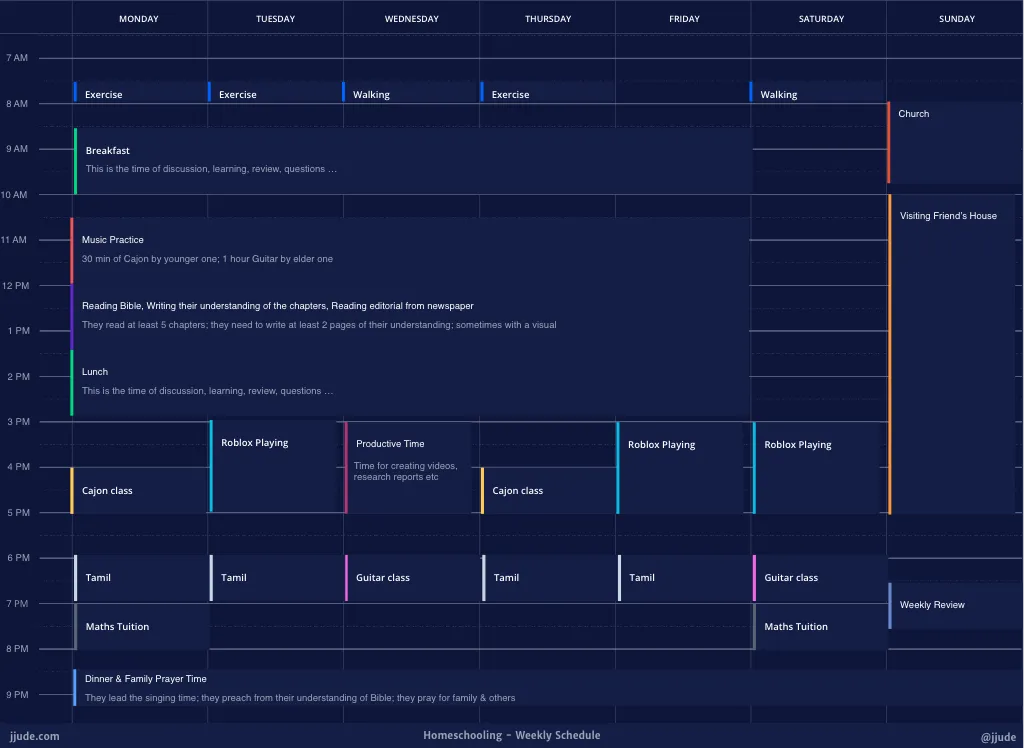
Most mornings began with some form of movement. On some days, they exercised at home. On other days, they went for a walk with their mother. For a few months in a year, this changed to swimming. That part did not need much pushing. It became routine.
After that, we had breakfast together. This was usually our first long conversation of the day. It was not planned. We would talk about what they read, something they noticed, or sometimes about companies, products, or news. These conversations often carried into lunch and dinner as well.
Late mornings were more structured. They would read a few chapters from the Bible and write what they understood. Sometimes they drew what they had in mind. They also read the editorial from the newspaper and explained it in their own words.
I did not sit and teach them through this. Most of the time, they worked on their own. If something felt unclear, I would step in, not to correct immediately, but to ask questions.
One evening, I remember asking, “How did you connect these two ideas?”
He paused for a bit and said, “I thought they were related.”
“What makes you think that?”
After a few minutes, he said, “Maybe they are not.”
That was usually enough. I did not feel the need to correct every mistake. If they stayed with the process, clarity would improve over time.
Afternoons were different. This is where most of the change happened over the years.
In the beginning, they spent a good amount of time playing on the computer, mostly Roblox. I did not remove it. As long as they had done a few meaningful things in the day, I was fine with it. My rough rule was simple: if they managed three or four important things, the day was good.
Alongside that, they created videos. They would come up with an idea, write a basic script, record, and then edit. It was not polished work. I did not expect it to be. My only expectation was that they completed something.
Over time, this shifted. They started doing courses online. I introduced them to Scratch, and later they explored some basic programming. They began building small things on their own. One created a simple portfolio site the way he liked it. The other made a photo album. They did not understand everything behind the code, but they understood what they wanted the output to be.
The afternoons became a mix. Some days they worked on projects. Some days they read. Some days they went out for youth meetings. Some days, especially for the younger one, included a long nap. It was not tightly controlled.
What held this together was not the schedule, but the weekly review.
Every Sunday, we sat down together. They would talk about three things: what went well, what could have been better, and what help they needed.
There was one rule. They could not use vague words. They had to be specific.
Instead of saying, “I could have done better,” they had to say what exactly was off.
“The lighting was poor in my video.”
“The title was not interesting.”
“I moved too much while recording.”
This took time to learn. But once they got used to it, their thinking became clearer.
After that, they would plan the next week. I would ask them what felt natural to them, what they enjoyed, and what they wanted to do more of. Over time, they began to see patterns in themselves. They knew what they would return to without being told.
I often told them to pay attention to that and build on it.
Evenings had a few fixed activities. Music classes on some days. Tamil on most weekdays. Math tuition on specific days. We did not try to optimize this too much. These were simply part of the day.
Dinner was another shared space. They would lead the prayer time. Sometimes they spoke from what they had read earlier in the day.
Our conversations often returned to simple, familiar things. A packet of chips, a soap brand, or something we had bought. I would ask them who made it, whether they had seen it elsewhere, and what it might mean if one brand appeared more often than another.
“Why do you think this one is everywhere?”
“Maybe more people buy it.”
“What does that tell you about the company?”
From there, we would move slowly into ideas like sales, cost, and profit. Not in a formal way, but through examples they could relate to.
When the news covered something like the Ukraine war, we did not leave it at headlines. We pulled out a map. We looked at where these countries were. We spoke about how it might affect things we use, like oil. The aim was not to get every detail right, but to get them to ask better questions.
Over time, I realised that the schedule itself was not the main thing.
If they liked what they were doing, they would go deep without being told. I have seen them sit for hours reading when something interested them. At the same time, if something did not hold their attention, they would get distracted quickly, especially if a phone was nearby.
So we adjusted the environment when we could. Sometimes we stepped out to read or record. Not every day, but often enough.
Looking back, the schedule was useful, but only as a guide. What mattered more was that they did a few meaningful things each day, reflected on them regularly, and slowly began to take ownership of what they were doing.
That took time. It also required letting go of the need to control every part of the day.
If there is one thing that worked for us, it is this: consistency mattered, but not perfection. A steady rhythm did more than a perfectly followed plan.