Blessed Are the Poor in Spirit
Every earthly kingdom begins with strength. Christ's Kingdom begins with poverty.
The Sermon on the Mount begins with a statement that appears completely contrary to human intuition.
"Blessed are the poor in spirit, for theirs is the kingdom of heaven."
This is not merely the first Beatitude. It is the foundation upon which every Beatitude rests. Before Jesus speaks about meekness, mercy, purity, peacemaking, righteousness, or endurance under persecution, He first identifies the kind of person who can enter His Kingdom. The Sermon on the Mount does not begin with moral instruction but with the heart. Until the heart is right, everything that follows becomes either impossible or self-righteous.
This Beatitude answers three foundational questions.
- What does it mean to be poor in spirit?
- What is the Kingdom of Heaven that belongs to such people?
- What does Jesus mean when He calls them blessed?
# The Kingdom Belongs to the Poor
The word "poor" can easily be misunderstood because we instinctively think in relative terms. Every person is poorer than someone else. A man earning fifty thousand rupees a month is poor compared to someone earning five lakhs. A millionaire is poor compared to a billionaire. Relative poverty, however, is not the image Jesus uses.
The poverty described here is absolute poverty. It is the poverty of someone who has exhausted every possibility of helping himself. Imagine a family living in a temporary shelter. The parents work every day, yet the children still go to bed hungry. Whatever little food they have is divided carefully among the family. There is no savings to invest, no education that can immediately improve their condition, no opportunity waiting around the corner. Working harder no longer changes anything because the problem is larger than their own ability to solve it. Their only hope lies outside themselves. Someone must open a door. Someone must trust them. Someone must stretch a helping hand to lift them into a new reality that they cannot reach on their own.
Jesus deliberately chooses this picture because it accurately describes the human condition before God.
To be poor in spirit is not to think poorly of oneself. It is not false humility, self-hatred, or denying the gifts that God has given us. It is the recognition that there exists a standard of righteousness which we cannot attain by our own strength. We know what is right, yet we repeatedly fail to do it. We desire holiness, yet discover sin within ourselves. The deeper we understand God's holiness, the more clearly we recognise our inability to reach it through effort alone.
This is exactly the struggle that Paul describes in Romans 7.
For what I want to do I do not do, but what I hate I do...What a wretched man I am! Who will rescue me from this body that is subject to death?
He delights in the law of God, yet finds another law at work within him. He knows the good he ought to do but repeatedly finds himself doing what he hates. His conclusion is significant. He does not ask, "What new discipline should I adopt?" He asks, "Who will rescue me from this body of death?" The question itself reveals spiritual poverty. Paul has reached the point where he understands that his problem cannot be solved by greater determination. He needs rescue.
This also explains why Jesus repeatedly confronted the Pharisees. Their fundamental problem was not merely legalism but self-sufficiency. They believed they possessed righteousness. They believed they had successfully met God's standard. Consequently, they saw little need for grace.
In contrast, the tax collector in Luke 18 simply prayed, "God, have mercy on me, a sinner." Jesus declared that this man, not the Pharisee, went home justified. The Kingdom belongs to those who know they need a Savior because only they are willing to receive one.
The first Beatitude therefore overturns the assumptions of every human system. The world rewards confidence in oneself. Jesus blesses those who have lost confidence in themselves and placed it entirely in God.
# The Kingdom Is Different
The promise attached to this Beatitude is equally surprising.
"Theirs is the kingdom of heaven."
Jesus is not merely speaking about life after death. He is announcing the arrival of a fundamentally different Kingdom.
Every kingdom reflects the character of its king. Throughout history, kingdoms have often been organised around power, hierarchy, conquest, privilege, or uniformity. Some philosophies divide humanity into superior and inferior classes. Others reduce individuals to instruments serving the interests of the state. Still others insist that peace can be achieved only by making everyone think alike, speak alike, and pursue identical goals. These systems differ in method, but they share one assumption: human worth is determined by something external.
The Kingdom of Heaven begins from a completely different premise. Every human being is created in the image of God. Human dignity is therefore not earned but given. It does not depend upon intelligence, education, wealth, influence, ethnicity, nationality, or achievement. Every person bears the image of the Creator and therefore possesses immeasurable worth.
This truth has two profound implications. First, every person stands equally before God. Our gifts differ, our responsibilities differ, and our callings differ, but our worth does not. God is no respecter of persons. The God who called Moses also calls ordinary believers. The God who empowered Paul also equips His Church today. The Kingdom contains no first-class and second-class citizens.
Second, equality before God does not eliminate individuality. God does not create identical people. He creates unique persons, each bearing His image in distinct ways. Every individual possesses different gifts, different responsibilities, different experiences, and different callings. Unity in the Kingdom is therefore not produced through uniformity but through mutual service. The gifts of one believer exist for the benefit of another. Strength is exercised through service rather than domination. Leadership becomes stewardship rather than privilege.
This explains why the New Testament repeatedly commands believers to bear one another's burdens, encourage one another, forgive one another, serve one another, and build one another up. These are not isolated ethical commands. They describe the normal culture of God's Kingdom. A society in which every individual recognises the image of God in every other individual inevitably becomes a society marked by justice, compassion, generosity, and peace.
# The Kingdom Begins Now
Another important feature of the Beatitudes often escapes our attention. Only two Beatitudes contain promises expressed in the present tense.
"Theirs is the kingdom of heaven."
The remaining promises point toward the future. They shall be comforted. They shall inherit the earth. They shall be filled. Jesus intentionally begins with a present reality before speaking about future hope.
The Kingdom of God is both present and future. Its final fulfilment awaits the return of Christ, but its reign begins wherever Christ is acknowledged as King. The Kingdom is therefore not merely a future destination but a present reality. It is here and now.
When believers gather in the name of Christ, Christ Himself is present among them. Wherever people forgive instead of seeking revenge, serve instead of dominating, tell the truth instead of deceiving, and love instead of hating, the values of God's Kingdom become visible. The Church is called to become a visible outpost of that Kingdom within the kingdoms of this world. The Kingdom is not fully established, but it has already begun.
# The Kingdom Blesses
The final word that requires careful attention is "blessed."
Modern Christians often interpret blessing almost exclusively in individual terms. We think of good health, financial prosperity, career success, family stability, or protection from difficulty. Scripture certainly teaches that God cares for His people and delights in providing for them. Yet biblical blessing never ends with the individual.
When God blessed Abraham, He immediately revealed the purpose of that blessing: "I will bless you... and you shall be a blessing." Blessing was never intended to terminate upon the recipient. It was always meant to flow outward.
The same pattern appears throughout Scripture. Psalm 23 describes a cup that overflows. A cup overflows precisely because it contains more than its owner requires. Its purpose is not merely to remain full but to spill over. God's blessings are given in the same way. He blesses His people so that they become instruments of blessing to others.
The Beatitudes follow this same pattern. God receives those who recognise their spiritual poverty. He brings them into His Kingdom through grace rather than merit. He transforms them into citizens of that Kingdom. He then sends them back into the world as representatives of His reign. Those who have received mercy become merciful. Those who have received forgiveness forgive others. Those who have experienced grace extend grace. Those whom God has lifted up begin lifting others.
# The Kingdom Still Begins with Poverty
Every kingdom has conditions for entry. Some kingdoms require birth. Others require citizenship, wealth, education, military service, or political influence. Human kingdoms always ask the same question: What qualifies you to belong?
The Kingdom of Heaven asks a completely different question. It does not ask what you have achieved. It asks whether you have recognised your need. The first qualification for citizenship is not strength but dependence. The Kingdom does not begin when a person proves himself worthy. It begins when he realises that he cannot make himself worthy.
That is why Jesus placed this Beatitude first. Before He teaches us how citizens of the Kingdom should live, He tells us who can enter it. Every other Beatitude assumes this one. The meek, the merciful, the pure in heart, the peacemakers, and those who hunger and thirst for righteousness are all people who first recognised their spiritual poverty and came to Christ for mercy.
This is also why the promise is in the present tense. "Theirs is the kingdom of heaven." The Kingdom begins the moment a person abandons self-reliance and submits to the King. Entry into the Kingdom is not the reward for spiritual maturity. It is the beginning of spiritual life.
The world admires those who stand on their own feet. Christ welcomes those who know they cannot stand without Him. Every earthly kingdom begins with strength. Christ's Kingdom begins with poverty.
If you liked this, you might also like my other sermons.
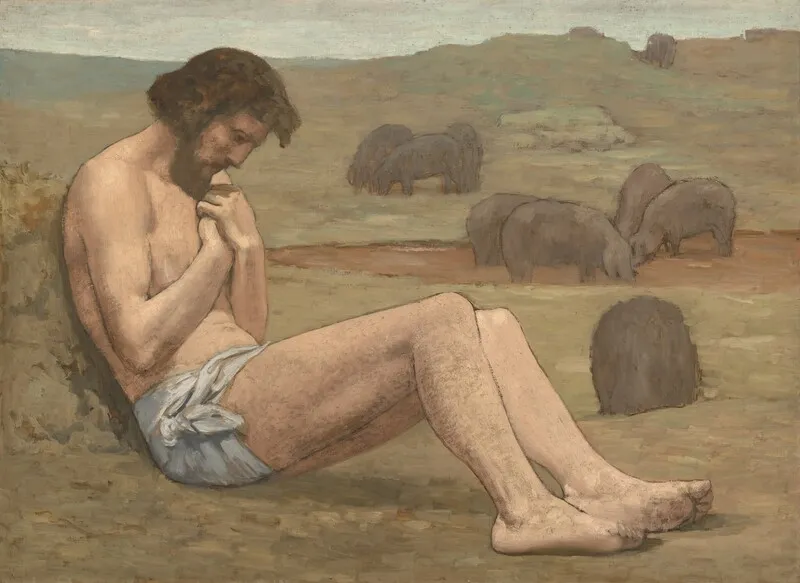
'Prodigal Son' Image by Pierre Puvis de Chavannes
Thanks to my e-prayer cell friends, Mohan Matthew, Anand Saju, Amutha Sheela, and Geetha, for the insights that shaped this meditation.
Under: #faith