When God Says No to Preaching the Gospel
God may say no even to preaching the gospel. And when He opens the door, He leads you to people you did not see in the vision. That is how God leads.
We are continuing our meditation on knowing the will of God and acting on it. In Go Before You Know we watched Samuel, and we learned to move when God speaks, even before we have the full picture.
Acts 16 shows us two things about how God leads. And both of them will surprise you.
The first surprise: God says no to preaching the gospel. Not to a sinner. Not to a backslider. To Paul and Silas, who are carrying out the last commandment of Jesus, going from town to town, the churches growing daily. The Holy Spirit shuts the door in front of them.
The second surprise: Paul sees a man in a vision. And the first person whose heart the Lord opens to the gospel is a woman.
That is how God leads. Let us walk through Acts 16 and learn it.
# God Says No to Preaching the Gospel
Look at verses 4 and 5. Paul and his companions are traveling from town to town, delivering the decisions that the apostles and elders in Jerusalem reached for the people to obey. The churches are being strengthened in the faith and growing daily in numbers. Paul is fervent. The gospel is going forward. Everything is working.
And then verse 6:
Paul and his companions traveled throughout the region of Phrygia and Galatia, having been kept by the Holy Spirit from preaching the word in the province of Asia.
They are doing exactly what Jesus told them to do: “Therefore go and make disciples of all nations” (Matthew 28:19). They are right in the middle of the Great Commission. And the Holy Spirit prevents them.
We do not know how. Was it sickness? Was it some other obstacle? Luke does not tell us. He only tells us that it happened. And he repeats it in the next verse:
When they came to the border of Mysia, they tried to enter Bithynia, but the Spirit of Jesus would not allow them to.
Notice the name. The Spirit of Jesus. The same Spirit who empowers the church is the one closing the door.
Some of us interpret every obstacle as the devil at work. Not here. This text is clear. The Holy Spirit prevented them.
You might be sharing the gospel. You might be doing the right thing. And the Spirit of God might be closing a door in front of you. You need to know that.
This is why we must know not only the open doors but also the closed ones. Jesus said He holds the key of David: “What he opens no one can shut, and what he shuts no one can open” (Revelation 3:7). So do not spend your strength trying to force open a door God has shut. He is not blocking your way to hurt you. He is guiding you to something else.
That is how God leads, sometimes: through a closed door.
# The Vision, Then Silence
In the night, Paul has a vision. A man of Macedonia stands and begs him: “Come over to Macedonia and help us” (Acts 16:9).
That vision would never have come if Paul had kept pushing into the province of Asia. He would have been restless, busy, frustrated, forcing a door that God had shut. Instead, he stopped. And in the stillness, God spoke.
They sailed from Troas, landed at Neapolis, and walked on to Philippi. And what happens there? Verse 12:
And we stayed there several days.
Several days. No preaching. No miracle. No new vision. Paul could have wondered: was my vision real? Did I obey the Lord, or did I follow my own imagination? He does not seem to have those doubts. But we would.
And what does Paul do while he waits? He does not sit idle. He does not demand that the Lord explain Himself. It was his custom, in every town, to look for a place of prayer. Philippi did not have enough Jewish residents for a proper synagogue, so the believers met outside the city gate, by the river. Paul goes there.
This is the lesson for anyone in a season of waiting. God may direct you to a place, and when you arrive, nothing is happening. No vision. No open door. Sometimes not even a place to pray. What to do?
As we saw in Go Before You Know, go with the lamp God gave you, path will start appearing before you.
# The Vision Said Man. God Led to a Woman.
At the place of prayer, Paul does something small. Verse 13: he sits down and begins to speak to the women who have gathered there.
The vision said a man of Macedonia. God sends him to a group of women by a river.
And among them is Lydia. A businesswoman, a dealer in purple cloth from the city of Thyatira. A worshiper of God. And notice what the text says: “The Lord opened her heart to respond to Paul's message” (Acts 16:14).
Not Paul's eloquence. The Lord opened her heart.
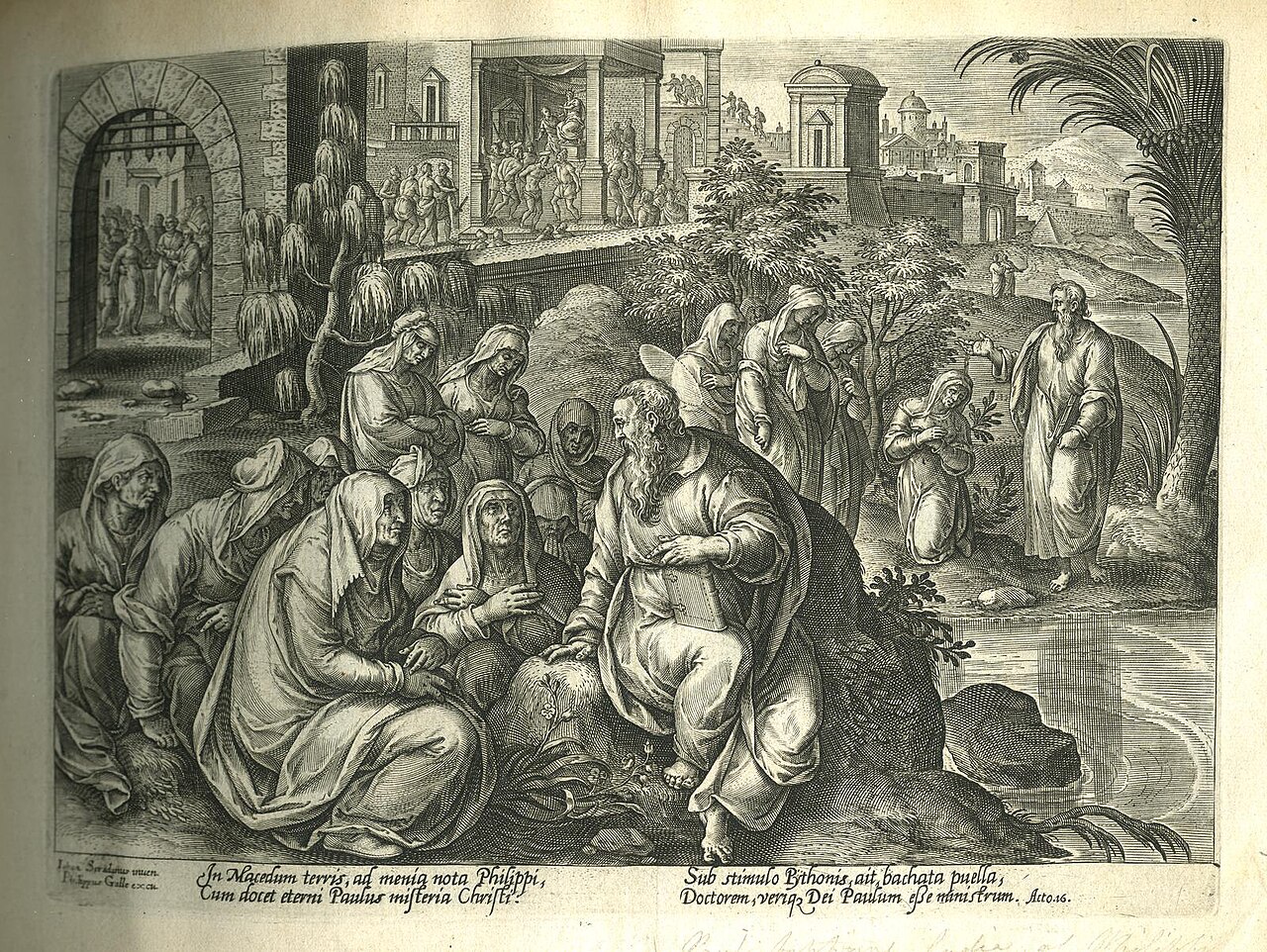
St Paul Speaking to the Women of Philippi
Now, Paul does not look at Lydia and say, this is not the man from my vision, so this is not God's will. He does not dismiss her because she is not what he expected. He preaches to whoever will listen. And the first heart the Lord opens in Europe is a woman's.
In Christ, Paul later wrote in Galatians 3:28,
there is neither Jew nor Gentile, neither slave nor free, nor is there male and female, for you are all one in Christ Jesus
The vision showed Paul the destination. It did not give him the audience list. God gave him the direction. God gave him the person. The vision said man. God said Lydia.
That is how God leads.
Lydia and her household are baptized. She invites Paul and his companions into her home. Things are going well. Paul might have thought: I am finally in the place of God's will.
# Freedom Collides with Money
The next time they go to the place of prayer, they meet a slave girl. She has a spirit of divination, and her owners make a great deal of money from her fortune-telling. She follows Paul and the others, shouting:
These men are servants of the Most High God, who are telling you the way to be saved.
The demons recognize the truth before the people do.
If the owners really believed what this spirit was saying, they would have believed Paul. They would have listened to the way of salvation themselves. But that is not what they do. They know exactly what their business is. It was never about the truth. It was always about the money.
Finally Paul becomes so annoyed that he turns and commands the spirit to come out of her. And at that moment she is free.
And what do the owners see? Verse 19:
When her owners realized that their hope of making money was gone, they seized Paul and Silas.
Freedom always collides with commercial interest. When you break the chains that someone else profits from, they will come after you.
# Obedience Does Not Shield You from Suffering
Paul and Silas are seized, dragged into the marketplace, stripped, beaten with rods, severely flogged, and thrown into the inner cell with their feet fastened in the stocks (Acts 16:22-24).
Now we can ask the question. They obeyed the Lord. They did not go where the Spirit shut the door. They went where He sent them. They preached. A woman came to faith.
Why this chaos?
We often assume that if we obey the Lord, troubles will not come. That is not what the Bible teaches, Old Testament or New Testament. Even Abraham experienced this. The Lord told him to leave his country and his father's household (Genesis 12:1). Abraham obeyed. He came to Canaan, and the first thing he found was not blessing but a severe famine (Genesis 12:10).
Did I hear the Lord correctly? Did I obey Him? Why is there a famine? Those questions come to every obedient believer. And subsequently, Abraham flourished. Obedience does not mean life gets easier. It means God is building your character, shaping you for what He wants you to do next.
About midnight, Paul and Silas are praying and singing hymns to God. Beaten from head to toe. Feet fastened in the stocks. And they are singing.
We start whining when the water does not come, when the electricity goes for eight hours, when the neighbor parks his car in front of our house. And here are two men, singing hymns at midnight.
And the other prisoners are listening to them.
Your worship in suffering is a sermon to unbelievers watching you.
# Where the No Became the Yes
Then comes the earthquake. The prison doors fly open. Everyone's chains come loose. They could have walked out free.
They stay.
And by staying, the life of the jailer, and his whole family, is saved. The jailer wakes, sees the open doors, and draws his sword to kill himself. Paul shouts: “Don't harm yourself! We are all here!” (Acts 16:28).
The jailer calls for lights, falls trembling before Paul and Silas, and asks the only question that matters: “Sirs, what must I do to be saved?” (Acts 16:30).
And they answer:
Believe in the Lord Jesus, and you will be saved—you and your household.
That hour of the night, the jailer washes their wounds. The converted enemy serves the prisoners he was guarding. He and his whole household are baptized. He sets a meal before them, and he is filled with joy.
Now look back at verse 6. Why did the Holy Spirit shut the door to Asia? We do not know then. But we can see now. It was for Lydia, waiting by the river. And it was for a jailer, and his household, in Philippi.
Paul did not know it at the time. That is how God leads: the no makes sense later. Sometimes years later.
We do not know the jailer's name. We are never told what became of him. But we will meet him one day. And he will be there because Paul submitted himself to the will of God, even when the will of God led him to a prison cell.
Sometimes the Lord takes you through the struggle to save one soul. One family. It is worth it to Him.
# God Leads in Broad Strokes
The next day, the magistrates send word: release them. And Paul is not going quietly. “They beat us publicly without a trial, even though we are Roman citizens,” he says. “And now do they want to get rid of us quietly? No! Let them come themselves and escort us out” (Acts 16:37).
Why did Paul not use this privilege the day before? He could have avoided the beating. He could have avoided the prison. Whatever his reasons, notice what he did not do. He did not use his privilege to escape suffering. And the prison is where the jailer was saved.
When the magistrates hear that Paul and Silas are Roman citizens, they are alarmed. They come, they appease them, they escort them out of prison.
And where do Paul and Silas go first? Back to Lydia's house. They meet with the brothers and sisters. They encourage them. And then they leave.
The church in Philippi survived. The prison could not stop it. The magistrates could not stop it. The gospel reached Philippi, and from Philippi it would reach Thessalonica, Corinth, and one day Rome itself.
If Paul had not obeyed, the gospel might have stayed in the province of Asia. It would not have reached Europe. Lydia would not have been saved. The jailer would not have been saved.
God's will does not micromanage every step. It sets the broad direction. Inside that direction, God gives you wisdom and freedom to act. Paul received one instruction: go. In Philippi, day by day, he made the daily calls himself: where to pray, whom to preach to, when to stay silent, when to assert his rights.
This word is not only for apostles and pastors and missionaries. It is for all of us.
# That Is How God Leads
God says no to preaching the gospel, and the no is not punishment. It is direction.
God opens a door, and the first person you meet is not the person you saw in the vision. And that is not a mistake. That is the plan.
Stop forcing one door you know God has shut, even if it is a door for the gospel. Keep one habit of prayer even when nothing is happening. Do not dismiss the person in front of you because they were not in your plan. And trust that the no you are living through is aimed at a yes you cannot see yet.
That is how God leads. He says no. He surprises you. And the no was always aimed at a yes.
If you liked this, you might also like my other sermons.
Image from Wikimedia Commons
Under: #faith