When to Fix the Worst, When to Back the Best
Building a flywheel of success for life and career
Psychologist Adam Mastroianni writes:
There are two kinds of problems in the world: strong-link problems and weak-link problems.
Though Adam introduces this to explain why science is a strong-link problem, I found it to be a powerful mental model for life. He defines the two types like this:
Weak-link problems are problems where the overall quality depends on how good the worst stuff is. You fix weak-link problems by making the weakest links stronger, or by eliminating them entirely.
It’s easy to assume that all problems are like this, but they’re not. Some problems are strong-link problems: overall quality depends on how good the best stuff is, and the bad stuff barely matters.
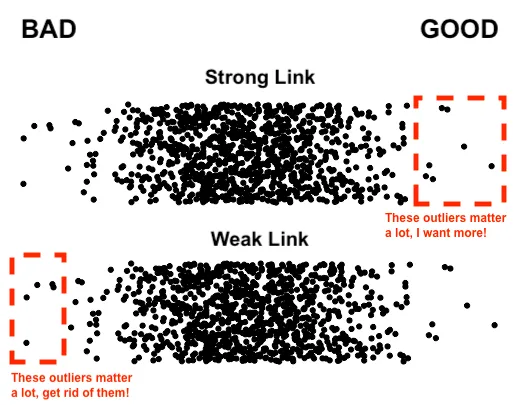
In other words: Weak links drag you down. Strong links lift you up.
Others have danced around this idea with different metaphors.
Eliyahu Goldratt, in The Goal, paints a vivid picture: a hiking group moving only as fast as its slowest member. If the weakest hiker stalls, the whole line crawls. It doesn’t matter how fast the leader is. That’s weak-link thinking—the system fails at its weakest point. But not everything works like that.
Clayton Christensen, the innovation guru, saw both sides. Sustaining innovation is weak-link thinking: improve the worst parts to keep things running smoothly. Disruptive innovation is strong-link: one bold idea can redefine the game. Fix bottlenecks to scale, but bet on big wins to dominate.
# Weak Links: Where Things Fall Apart
A defective $10 O-ring caused the $3.2 billion Challenger disaster. A pinch too much salt can ruin an entire dish. A single breach of trust ended Rajat Gupta’s otherwise illustrious career at McKinsey. Weak-link problems are brutal—one failure can crash the whole system.
Here are the fingerprints of weak-link problems:
| Trait | Description |
|---|---|
| Minimum quality matters | The weakest part sets the outcome. |
| Single points of failure | One flaw can break everything. |
| Fix by raising the floor | Strengthen or remove the weakest links. |
To tackle these, you build reliable systems, set non-negotiable standards, and add redundancy to catch cracks before they spread.
# Strong Links: Where Leverage Lives
One great book can launch an author’s career. One smart stock pick can return 10x, making up for a dozen duds. The best parts pull crazy weight.
Strong-link problems look like this:
| Trait | Description |
|---|---|
| Outliers drive success | One big win overshadows many failures. |
| Risk is rewarded | Experimentation uncovers game-changers. |
| Not easily optimized with rules | Innovation often comes from breaking them. |
Here, you make space for bold bets, try lots of things, and double down on what’s working. Follow the energy. Build on what wants to grow.
# You Need Both to Win
It’s tempting to chase only strong-link wins—those shiny, game-changing moments. But if your foundation’s shaky, you’ll never get off the ground. A world-class surgeon can’t save a life with unsterilized tools. A brilliant coder can’t ship if the build system is broken. You need solid ground to launch big leaps.
Take India as an example. Indian talent shines abroad—think CEOs like Satya Nadella or scientists at NASA. But at home, corruption, red tape, and a culture that often punishes bold thinking act like weak links, holding back brilliance. It’s not a lack of strong links—there’s plenty of genius. It’s the weak-link systems that don’t give it a stable runway.
As Newton said, “If I have seen further, it is by standing on the shoulders of giants.” True. But even giants need firm ground beneath them.
# WINS: My Framework for Applying This
I’ve started using this weak-link/strong-link lens to guide my life through a framework I call WINS: Wealth, Insights, Network, and Self. It’s my spin on ideas from Rabbi Daniel Lapin and others, distilled from years of reading, living, and experimenting.
Each part needs both weak-link fixes (to stabilize) and strong-link bets (to soar). Here’s how I approach it:
-
Wealth: I start with weak-link thinking to secure the basics. I’ve been debt-free for over a decade, which gives me a solid foundation. But I also make strong-link bets, like investing in stocks. I bought TVS Motors at ₹40; it’s now over ₹2,800. Ashok Leyland and SJVN were similar home runs. Those wins, plus dividends covering 80% of my expenses, show how one great pick can change the game. Weak links fix leakages; strong links make you rich.
-
Insights: Ideas are my fuel. I subscribe to too many blogs and buy books I may never finish. That’s okay. Most are noise, but every so often, an idea like Mastroianni’s rewires my brain. I gather insights like a bee collects nectar, knowing one glint of gold can shift everything. Weak-link move: skim and discard what’s not useful. Strong-link move: chase the ideas that spark something big.
-
Network: I don’t chase every conference, but I invest in coffee, conversations, and small gestures for people I admire. I keep my word. Every major career break I’ve had came from one or two key connections. Weak-link move: build trust consistently. Strong-link move: nurture the relationships that open big doors.
-
Self: This covers health and parenting. For health, I focus on weak links: no soda, no junk food, regular workouts, and swimming half the year. I don’t aim for Olympic fitness—just enough to stay functional for big goals. For parenting, I homeschool my sons, inspired by Paul Graham’s idea that we get only fifteen summers with our kids. I read to them, share mental models like this one, and encourage them to chase what they love. Weak-link move: keep the basics (health, time) solid. Strong-link move: inspire them to find their own breakthroughs.
Even in my work as an engineer, this applies. A single buggy test or unpatched server can crash a system, so we automate the boring stuff and enforce standards (weak-link fixes). But we also need strong-link bets—new features or bold rewrites—to stay ahead. Reliability clears the runway; moonshots take flight.
# It’s a Dance That Builds Momentum
Raise the floor. Reach for the ceiling.
Rinse and repeat.
That’s how you win—not in one grand swoop, but layer by layer. Fix what threatens to break. Then bet on what wants to grow. It’s a quiet rhythm of repairs and risks, sustained over years. And every now and then, a strong-link moment—a breakthrough, a connection, a stock that soars—propels you forward, built on all the groundwork you laid.
Under: #frameworks , #wins , #coach